Welcome to part 30 in a series of non-fiction book reviews, originally based on the idea that the books I request tell you everything you need to know about me. I have, after so many chapters of this series, realised that all these posts say about me is that this was just a place to put these reviews! I can see how broad my non-fiction reading is, and how many interesting, good (and sometimes not-so-good) books and topics I've had a chance to explore. Today I'm reviewing two books from the Object Lessons series from Bloomsbury press, which I was given e-Arcs from NetGalley for and a kids book about bikes.
Stock Photo (Object Lessons) by Simona Supekar

Part memoir, part cultural criticism, Stock Photo mines the significance of the stock photo in our everyday lives, from the ads and websites we browse, to the menus and memes that we consume. Through interviews with stock photography experts, photographers, models, consumers, and other stakeholders, Simona Supekar explores the evolution of the industry by tracing the creation of a stock photo from concept to usage while highlighting significant historical moments.
Supekar weaves in her own experiences as a keyworder for a stock photography company while reckoning with her Asian American/South Asian identity in a post-9/11 world. Stock Photo also addresses how these images have the power to shape our perceptions about race, class/caste, gender, ability, and more, thus underscoring the importance of representation even in something as innocuous as a stock photo.
This book is overtly political. It starts with some chat about genocide that seems irrelevant for the topic at hand, and then settles in to attempt to use the concept of stock photos to ... to what? And that's the core issue with this volume. As Superkar reflecting on her own experience? Trying to show how the contents of stock photos reflect our racist past and present? To talking about the job at a stock photo company? This jumps around a lot. While I always enjoy these books more when the titular object is used to reflect the author's experience, for us to learn something about them or them to learn something about themselves, in this instance it seemed jumpy and disorganised. The facts and the memoir are sitting side by side, rather than illustrating each other. It's a bit repetitious, although commenting that racism is a bit repetitious may be disingenuous. I think Supekar has something to say, but I think she would have got her message across with clarity if the chapters had contained what was in the chapter headings instead of veering wildly around.
Microphone (Object Lessons) by Ralph Jones
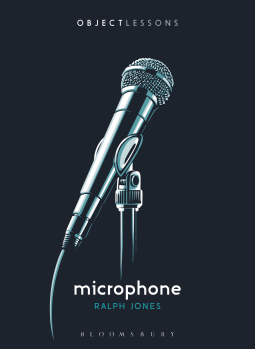
Since its invention more than 150 years ago, the microphone transformed the world in an instant. In the 21st century, every phone has a microphone. Every laptop has a microphone. Everyone with a microphone has a podcast. The microphone wields enormous power. But when we're ‘on mic’ we aren't just powerful, we're vulnerable. Microphones can destroy careers as quickly as make them. Microphone takes a curious, always humorous look at this metaphor for power and how the fulfillment of this need to be heard has created a multi-headed beast we are still learning how to tame.
This is a fairly straightforward history of the microphone. It reflects on who it was invented, how it has been used and where it sits in our (Western, privileged) lives. I learnt a bit, and it helped me think a bit about a common object that I use every day and haven't ever really considered

Learning to ride a bike requires a leap of faith, and as a father teaches his child to ride, the child worries that Dad will let go before they’re ready. But with patience and persistence, father and child learn together that pedaling and letting go are part of the same thrilling ride.
From the Caldecott Honor-winning creators of A Different Pond comes a new picture book that encompasses three generations, two languages, and one universal experience. This bilingual story in English and Vietnamese explores a child’s trust, a parent’s guiding hand, and the paradox of loving and letting go.
I don't often request children's books from NetGalley, since I'm not the target market and also a lot of the illustrations are AI and I cannot deal with it. I requested this because the illustrations are beautiful, I'm a bike rider and Vietnam holds a special place in my heart, I've ridden bikes there. This book was so beautiful and heartwarming, The illustrations are wonderful and real, and the duel storyline is touching. i found it particularly resonant because when i visited Vietnam we hired bikes which were like the ones in that part of the story and met a Vietnamese guide who lived in a small house like the one in the story. For children, the message about doing hard things is beautifully told. for grown-ups sharing the story the passing down of important skills generation to generation is a beautiful message. I loved this, and would very much like to buy a physical copy for a child of the appropriate age.
Comments
Post a Comment