Welcome to part 34 in a series of non-fiction book reviews, originally based on the idea that the books I request tell you everything you need to know about me. I have, after so many chapters of this series, realised that all these posts say about me is that this was just a place to put these reviews, but now I can see how broad my non-fiction reading is, and how many interesting, good (and sometimes not-so-good) books and topics I've had a chance to explore. This time we have 2 books about specific albums and one about LGBTQ+ folklore and that one wasn't even a NetGalley book, but it is non-fiction, so I'm including it here. The other two books were provided by NetGalley in exchange for an honest review.
Paul Simon's Graceland (33 1/3 Africa) by Kalvin Schmidt-Rimpler Dinh

Celebrated, controversial, and conspicuously eclectic, Paul Simon's Graceland stands among the monumental albums of the 20th century. This book explores how and why it made its mark, from the international collaborations that defined its musical character, to the inflamed political environment from which it emerged.
Graceland incorporated some of South Africa's most beloved popular music traditions, including 'township jive', kwela, and the intricate isicathamiya harmonies of Ladysmith Black Mambazo. It also featured contributions from Central and West African musicians, alongside an array of North American styles – Chicano rock, country, synth-pop, Louisiana zydeco – and, of course, Simon's characteristically abstract poetics.
This book revisits Graceland as an important example of the global relevance of African music. Released in 1986, amid an intensified period of anti-apartheid activism across world, the album had a unique relationship to South Africa: it drew attention to apartheid and Black African music while its popular significance was simultaneously propelled by the anti-apartheid movement. As a collaborative, cross-cultural project straddling the boundaries of a deeply unequal world – economically, politically, racially – Graceland invites reflection on the relationship between art and politics, both then and now.
Like all the books in this series, Graceland starts with a general introduction discussing Paul Simon, and African music and then goes track by track through the album. For reasons (presumably copyright) there are no blockquotes from the songs, but only references to what lines they are. I found this remarkably annoying. Like the rest of this series, it is all based on secondary sources, carefully footnoted over the final few pages of the book. Since Paul Simon is famous for not talking about the meanings of his songs, this didn't reveal that much. There is a final chapter addressing various controversies around the album.
I love the album Graceland. For some reason it's our "cooking music" - put it on, make dinner and the album will be done at the same time as dinner. This book provided some deeper context and background to the music. I also found it repetitive, and organised in a way that didn't hold my interest. I think this might have been a me problem. I certainly now know more about South African music than I did before reading this book.
The Cure's Disintegration (33 1/3) by Andi Harriman

This book begs the question: why should an album make you feel good?
In 1989, The Cure's Robert Smith was going to turn thirty years old. His fears and anxieties of age-having not yet written his pinnacle album-caused Smith to embark on the band's undoing with Disintegration. The result was an LP drenched in melancholy sublime, a beautiful decree of breaking down to build anew. From the fame and notoriety of The Cure after their hit, “Just Like Heaven,” to the departure of the only other consistent band member, Lol Tolhurst, it's clear that the grisly spiral into the depths of pain is stamped throughout Disintegration.
This book explores the depths of Smith's masterpiece by way of the French Modernist Charles Baudelaire and his poem, “Spleen.” Much like Smith, Baudelaire took his temperament and softened the edges of sorrow, transforming it into a mass of supercharged emotion: a tenuous concoction of sin and sex, lust and monstrosity, self-hatred and fear… all cauterized by the malaise (and acceptance) of eternal melancholy.
And through Disintegration lies Robert Smith's corpus-his spleen. It's here that The Cure's upheaval and Smith's heroic martyrdom became the catalyst for his masterpiece.
When I was 16 I started loving the Cure. The lyrics, the swelling music, the way Robert Smith seemed to understand my feelings. I still listen to The Cure when I'm in a melancholic mood and wish to wallow. So I was interested to learn more about Disintegration and the band.
This book is odd. It starts by comparing Robert Smith with the French poet Baudledere. Why? because they are both melancholic? It's hard to understand the comparisons, especially in this context, where the book purports to be about not just one band, but one specific album. At one point Harriman describes it as having two protagonists, but the comparisons feel forced, artificial and unnecessary. I found this volume heavy going, and drifted off without finishing it. Maybe i should go investigate Baudledere and then return to it.
Queer As Folklore: The Hidden Queer History of Myths and Monsters by Sacha Coward
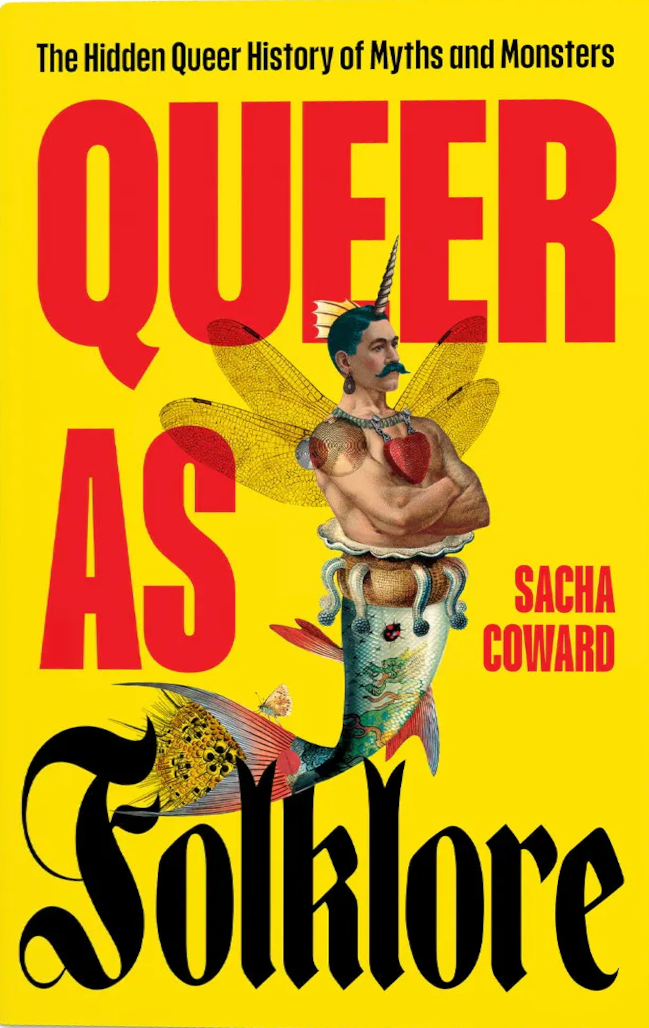
Queer as Folklore takes readers across centuries and continents which reveals the unsung heroes and villains of storytelling, magic and fantasy. Featuring images from archives, galleries and museums around the world, each chapter investigates the queer history of different mythic and folkloric characters, both old and new.
Leaving no headstone unturned, Sacha Coward will take you on a wild ride through the night from ancient Greece to the main stage of RuPaul’s Drag Race, visiting cross-dressing pirates, radical fairies and the graves of the ‘queerly departed’ along the way. Queer communities have often sought refuge in the shadows, found kinship in the in-between and created safe spaces in underworlds; but these forgotten narratives tell stories of remarkable resilience that deserve to be heard.
Join any Pride march and you are likely to see a glorious display of papier-mâché unicorn heads trailing sequins, drag queens wearing mermaid tails and more fairy wings than you can shake a trident at. But these are not just accessories: they are queer symbols with historic roots.
To truly understand who queer people are today, we must confront the twisted tales of the past and Queer as Folklore is a celebration of queer history like you've never seen it before.
My father once asked me if I see everything through a feminist lens. I thought about it, and realised that yes, that is my primary reading. Sacha does the same thing, but with queerness. Everything is queer. It's an inclusive queerness, but one that is kind of shallow. So, while much of this book is interesting, a lot of the queerness feels like a reach. It's not just that queer people like unicorns, it's that unicorns are queer! So are pirates! and mermaids! And fairies! and space invaders (this one was where it really lost me). If you don't see it, it's because queerness has had to be hidden.
Author Sacha Coward doesn't draw a distinction between "there were Queer people involved" and "it's Queer". So, because we know that there were homosexuals involved in the development of modern computing, computers are Queer. I don't see it that way. I think the looking for visibility for a community that has traditionally been erased is important, but the claiming everything for gayness is a very limited world-view.
This almost feels like a series of blog posts or podcasts on the theme, rather than a cohesive book. I listened to the audiobook and the narrator was great.
Comments
Post a Comment